Deeply affecting, incredible piece of journalism. Seamlessly weaves real life narratives and historical context.
Best fictional book about the end of the war. Nuanced and humane. Must read for anyone with a passing interest in Sri Lanka
A heart-wrenching account of the Sri-Lankan civil war, this is a must read book. I had no background knowledge of the conflict, and found the details of the war shocking and tear-inducing. Would recommend that everyone reads!
Syria gets most of the attention these days but the aftermath of the Sri Lankan civil war is clearly ongoing. A deep dive into 3 lives. I would have liked to have had more history and description of the conflict throughout the book. And a character from the other side. Great writing and reporting.
Excellent, devastating introduction (for me, at least) to the Sri Lankan civil war, told via two individuals' stories. Thoroughly researched and reported. I have some snits about the structure (there were a couple of late revelations that seemed odd, for different reasons), but overall I highly recommend this.
Absolutely fantastic. What is it like to be in a civil war? What is it like to survive a race riot? To what limits of cruelty and bravery, dedication and maternal love can a person go? The Seasons of Trouble is a remarkable read, with some events so troubling and striking that you will never forget them. Gives the lie to the glamor of war in its portrayal of a story that happened in recent years that was yet one more dull headline in our privileged daily lives.
Pulling back the curtain reveals that story in a new fashion, and the remarkable lengths to which both human love and communal hate can take us. Reminds me of Behind the Beautiful Forevers—stunning, poignant, foreign, and true. Do yourself a favor: buy it and read it!
A carefully narrated account of how the disruptions of war reshape the lives of the participants. The author’s conversation on the Sources and Methods podcast brought me to this; I’ve done a smattering of readings elsewhere but this is my first book-length introduction to the conflict in Sri Lanka. It brings a strong sense of the conflict’s contours, even as it focuses primarily on the lives of a handful of characters and does not indulge in a lot of background information dumping at the outset, preferring to spin out the context as it goes along. I’m mindful that the voices we hear are those from the minority Tamil community; that’s not a shortcoming as the story of their experience is still quite powerful on its own, but the incumbent Sinhalese regime is largely present as an opaque brutalizing force, either displacing and corralling the book’s main witnesses or targeting them for personal torture and detention. These accounts are awful, enraging, and really convey the powerlessness of their victims against a state determined to crush out dissent. (In this book the Tamil Tigers play a somewhat more peripheral, but just as profound, role in the lives of the protagonists; there is a lot of rich narrative background here for case studies of how rebel movements socializes its cadres and establish control over a population, which I assume other books focused on the LTTE have also elaborated upon.) For an understanding of the higher-level calculations of the Tigers or the regime, and the apparently major political shifts that have occurred over the past year since Rajapaksa’s ouster, I’ll have to read further, but as an introduction to the conflict’s most recent major denouement, and the deep scars that it appears to have left on the country, this was a powerful read.
A Civil War in a place most people cannot find on a map doesn’t make front page news, despite its horror. There is a quote often attributed to Stalin that reads, “One death is a tragedy, and one million deaths is a statistic.” It is the author Rohini Mohan’s intent to take these foreign statistics and make them flesh and blood. Two people, one falsely arrested under a terrorism charge, the other a long time Tamil Tiger attempting to leave the movement, are both caught up in the wrong side of the Sri Lankan Civil War. This story is often told by the government where the Tamil Tigers were terrorists. Mohan shows us that they are a people that were long oppressed by the government left with no choice to fight or become subservient to a Sinalan dominated government bent on bowing them. There is another proverb, "Until the lion has his or her own storyteller, the hunter will always be the hero.” This book is an attempt to show the side of the lions (or perhaps Tigers for that matter).
Sarvanantha Pereira ("Sarva") is an honest man trying to make a living and honor his family. One day he is accosted by unknown agents who capture and torture him. They attempt to get a confession, that he was a member of the Tigers. He refused to sign and his real nightmare began. A seemingly unending series of secret trials and secret prisons keep him bewildered and scared. His injuries and trauma he would keep for the rest of his life. It is only until after the end of the Civil War is he released and with the help of a local NGO escapes to London.
Mugil’s history is intertwined with the Tamil Tigers. Her parents moved deeper into Tamil territory in the earlier years of the 30-year civil war. The north and east parts of Sri Lankan were considered protected by the rebel groups. “Mugil’s father had always said that in Sri Lanka there were some districts where the army or government could not hurt even a Tamil fly: Kilinochchi, Mullaitivu, part of Mannar, north Vavuniya, and southern Jaffna—collectively the Vanni.” (p31) Mohan tells of Mugil’s time with the Tigers as a soldier. Her length of time with the Tigers would document the fall before the final defeat. New fighters would get younger and younger until young girls were sent into the field barely able to hold their rifles and Mugil is recalled into active duty to lead them. It is at this point she realizes the coming defeat and leaves. She and her family would become refugees and later relocated by the government to places unfamiliar to them for easier control.
Mohan’s book is a detailed account of the impact of war on individuals. It is a sort of people’s history of the Sri Lankan Civil War mostly just giving the Tamils’ perspective. It is an important book as any media that does pick up the impact of war show up in Bollywood films like Peck on the Cheek or more recently Chennai Express. There is a real loss and the impact of war is the same everywhere. It becomes isolated, far away, and foreign, but the ramifications of the actions anywhere have an impact on everyone everywhere. This is a critical book on war.
This book gave me a rich understanding about the civil war in Sri Lanka between the Sinhalese and Tamils community that happens for more than 2 decades. Rohini Mohan's writing is so engaging and beautiful, and she tells the story of the 3 characters in this book (Sarva, Indra and Mugil) with a vivid detail. It reads like a novel yet feels so immediate as well.
SOOOO good, I got so invested in the lives of the people Mohan follows and I think she does a great job of explaining the nuances of the conflict to readers without being overwhelming
This was the best book I've read all year. Incredible storytelling, clearly well-researched and thoughtfully put together - she tells the real stories of three people (and their families) during and after the Civil War in Sri Lanka in a raw and honest way. I find that books of this style - where the author is telling someone else's story - often run the risk of coming across patronising or with too much of the author's perspective, but this book avoids those traps completely.
I read this while travelling around Sri Lanka. At times it was a little jarring to read something so brutal while being surrounded by such beauty, but it was an important reminder for me of Sri Lanka's recent history. I can't recommend reading this book enough - particularly if you're travelling to Sri Lanka, but also as a human and personal way of learning about a brutal and violent time in our collective recent history.
So richly told that I sometimes forgot this was non-fiction. Superb.
Amazing book! Rohini Mohan has expressed the stories of three lives trapped in Civil war of Srilanka.
Gut wrenching, disturbing and thought provoking.
Heart-breaking. I was shocked at how little I knew about events that happened right next door.
A riveting book.
Made me wonder ... what if other wars and conflicts are seen through the eyes of women caught in them.
Incredible reporting on the lives of two families during the end of the Sri Lankan civil war. This is a must read for those interested in learning about what gets left behind on the American news room floor.
An exceptional book, which gives a different face to a war where we thought it was easy to spot the bad guys and the good guys, but the truth is much more blurry. This author captures that brilliantly, offering a true story that reads like a novel.
This is one of the best books I have ever read in my entire life. Gripping, exhilarating, haunting -- these words barely scratch the surface of this account of the lives of the three main people the author introduces to us. Though it's non-fiction, The Seasons of Trouble reads like a novel with history of the Sri Lankan civil war interspersed amid the peoples' stories. You will get to know Mugil, Sarva, Indra, and all of their families and friends intimately while also learning about their country and the war that affected them all. When I wasn't reading, I was thinking about these people and I am genuinely sad to see them go. I'm eagerly awaiting more work from Rohini Mohan -- she is one to keep an eye on!
One of the most articulate narrative of unrest I have read in recent times. Religion is the single most dividing factor which holds humanity at stake. Mindless violence and discrimination is all explained easily without a blink of the eye and accepted by most as a logical explanation. I am enthralled by this book. The narrative is so jointed and precise that I want to congratulate the author on her dedication to her craft. I shed many a tear while reading, but it gave me a complete perspective of the LTTE. The saying that one man's terrorist is another man's freedom fighter stands true. Though one always has a stand to take , its very difficult to justify.Words are just words and nothing can pacify any injustice meted out in the name of one's caste and religion.I will recommend this book to all.
This was a difficult read. Chronicling the Civil War in Sri Lanka through the lens of three people that were right in the middle of it, the book unfolds almost like fiction. This seems like a deliberate tactic by the author, either to help the reader cope with the trauma that plays out or to make for effective storytelling. It works on the second count, leaving you with more despair than hope. We're left with incomplete pieces, something the author mentions in the preface. '...loose ends rarely tie up. Incompleteness and dread are as tangible as the deaths and destruction.'
I think what might have made this piece more rounded is a narrative from the other side. At the centre of the conflict are stories of people stuck in the middle; collateral damage to two sides that are poles apart, yet eerily similar. What was the human experience of a person fighting on the side of the State? How did he deal with the fear of facing the other side, even as he had the State backing him. Did his experiences of the war bring him closer to those he labeled the 'other', or did it further the chasm? While the author tries to draw out the biases of the three people central to her story, this gap seems to be evident. She's telling one side of the story, albeit effectively and in great detail. It's the story of the underdog, but how interesting would it have been to have caught a glimpse of the other side in their own words?
Regardless, I would recommend this to anyone looking to understand the civil war in Sri Lanka, especially from a more personal lens, rather than a ‘political’ one. The personal is most definitely political. Brace yourself.
Extremely detailed, sharing various perspectives of a traumatic event that spanned multiple decades. Highlights discrimination towards all ethnic groups in Sri Lanka to various degrees. Somewhat objective accounts (perspectives change throughout the retelling) to provide a glimpse into the mindset of someone who lived through the civil war. Could be triggering for those who've undergone a similar experience.
Growing up as a boy in South India, I only knew the vague contours of Sri Lanka's civil war. But beyond the official 'terrorist organization' tag of the LTTE and the tumultuous relationship between India and Sri Lanka in the wake of the assassination of Rajiv Gandhi, I didn't know much about the country at all. SEASONS OF TROUBLE by ROHINI MOHAN not only told me about the facts of the Sri Lankan civil war but also made me empathize with every single victim of the system of war, whether Sinhalese or Tamil.
You've probably read from the plot synopsis that the book traces the life and travails of three Sri Lankan Tamils through the civil war and after it. But, more than that, the book tells as much of the stories as it can of the people surrounding these three protagonists. Children, mothers, husbands, brothers, friends, business partners, accomplices, social workers, almost everyone in the country is trapped in a cycle of hate, frustration, and misery caused by the interminable conflict.
However, even within these troubled times, Ms Mohan manages to show us the ways in which ordinary people eke out joy whether it's Sarva's mother and aunt cooking his favorite food to deliver it to him in prison or Mugil's family play acting a revolution to feel like victors rather than victims in the war.
Every single sentence in this book is meaningful and intent-ful. Although the term is often overused on bestseller backflaps, this book is actually 'unputdownable'. If you only read one book this year, let it be this one.
"Victimhood morphed into martyrdom, non-participation became betrayal. The idea of Tamilness was community action, not silent suffering. Militants had usurped the voice of Tamil protest in Sri Lanka..."
.
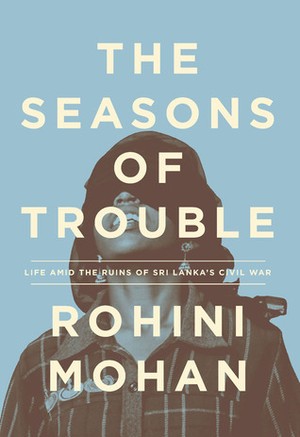
THE SEASONS OF TROUBLE: Life Ali's the Ruins of Sri Lanka's Civil War by Rohini Mohan, 2014 @versobooks
#ReadtheWorld21 📍 Sri Lanka
Journalist Rohini Mohan spent 5 years following three people through the last days and aftermath of Sri Lanka's Civil War. This war took place for 26 years between the majority Sinhalese and the secessionist Tamils who wanted to establish their own country in the islands northeast. Conflicts (arguably) ending in May 2009 with the Tamils defeat. The book delves into this aftermath and reconstruction of landscape and lives.
All three people she profiles are Tamil, a large minority population in Sri Lanka. They are largely Hindu, but there are also Muslim Tamil populations in Sri Lanka, and speak the Tamil language. The majority Sinhalese are largely Buddhist and speak Sinhala.
We meet a mother and son - Indra and Sarva. Sarva is recruited by the Tamil militia that becomes known as the LTTE, or the Tamil Tigers. They both share their history, Indra's in the early days of the conflict and Sarva at the end, including imprisonment and torture, and his eventual flight/and asylum seeking in the UK.
The 3rd narrative follows Mugil, a woman who was an LTTE child soldier, learning to fight and kill in her pre-teens. She details the life and stigma of women soldiers. She later moves up in the ranks of the militia and is able to marry and have a family. She eventually leaves the LTTE to care for her own parents and children after their reunion.
Through their stories, Mohan details the modern post-colonial history of #SriLanka, and the rising tensions between the Sinhalese and Tamils after the British left in 1948, the formation of the government in 1972, and the turmoil and ethnic / religious violence that lead to the long War.
This book is incredibly detailed and immersive, with alternating narratives of Sarva and Mugil during and after the War, and their own reconstruction of their lives.
I learned so much about this conflict, and about the modern history and various cultures of Sri Lanka, and the plight of many Sri Lankan Tamils who fled the country as refugees, and others who stayed...
An exemplary book on the subject, both in form and substance. The writing was so immersive and impactful, even when she writes about the horrible acts of violence in the War. Mohan stays completely out of the story herself the full focus on her subjects - sharing heir stories and their lives.
Hard-hitting! Will make you re-evaluate your privileges. A must-read!
Too overwhelmed to write a detailed review. Maybe soon.
In 2008 the Sri Lankan government ended its decades-long civil war with a brutal final campaign to destroy the separatist Liberation Tigers of Tamil Eelam. This is the story of that troubled history told through the lives of three people who lived through this conflict, and whose lives are still shaped by its reverberations. The narrative arc begins in the 1980s, leading to the final battle and defeat of the Tigers in 2008, and concluding with the uneasy aftermath of the government victory.
The political history of the conflict is dealt with mostly as subtext, which was a bit disappointing to me. But where the book does excel is at humanizing the struggles of Sri Lanka's Tamil minority. The aftermath of the war and struggles of former LTTE cadres is particularly moving. For these cadres, Prabakaran and the Tigers were their entire world. Memorializing the defeat and the thousands of Tamils tortured and killed is forbidden by the Sri Lankan state, which is eager to move forward and put a tidy Pangloss on all past events. But it's unclear how any society can simply suppress its demons forever. That clandestine memorials and reminiscences still take place shows how hard it is to suppress human feeling through brute force. Instead of a real reconciliation, what is created is something closer to the peace of the graveyard. Although the events are about Sri Lanka, this is clearly a universal story.
For those wanting to familiarize themselves more with the basic history of the conflict, I recommend "The Cage," which is more of a political history. But this book does a great service by telling the intimate stories of those who actually lived through the conflict. Elegantly written, it fills in a lot of color about the civil war and the people whose lives it shaped. The harassment, frustrations and efforts to try and survive in reduced circumstances after the fighting is over are all movingly portrayed as well. I imagine that Syrians and others will be able to relate to some of these melancholy stories in the years ahead
All in al this is a worthy companion to broader study on Sri Lanka, as well as a literary achievement in its own right.
I am always skeptical when I pick up books on the 26 year civil war in Sri Lanka. As a Tamil myself, I was raised hearing stories of what it was like for my family to live in Sri Lanka as Tamils during the time when the Sri Lankan government enforced discriminatory policies against minorities. I absorbed the stories of riots, and what it was like for family members to flee the shelling as refugees. But I also heard what it was like to be Tamil, growing up in the heart of the Tamil community during this time, in fear of the Tamil Tigers. Those latter stories seemed to sit at odds with the fervent support that the Tamil Tigers received from younger Tamils within the global diaspora. But I knew that they were true, and I understood the frustrations that many people have with the romanticisation of the Tamil Tigers. That was only confirmed to me when I travelled to Sri Lanka and listened to people in and around Jaffna talking about their experiences of the war. It was clear to me that there are so many varied experiences of the war, and a spectrum of relationships that Tamils had to the Tamil Tigers. United, though they were, on the notion of liberation, they were certainly varied in their opinions on how to attain this.
Rohini Mohan’s book explores these difficult relationships that Tamils had with the Tamil Tigers in a way that I have not seen before. Rohini pulls you into her characters’ individual struggles as they grapple to make sense of the war that cost them their homes, livelihoods and families. There are those who have unwavering allegiance to the Tigers; those who are horrified by the Tigers; and those in-between, whose internal battles we are privy to, as they try to ascertain their own feelings about the Tigers as the war becomes increasingly unstable. We see the war from so many perspectives - soldiers, mothers, children (and all 3 in 1). Through one of the storylines, Rohini also very carefully deconstructs sexist notions of a female militant fighter.
Though this book does not delve into a deep analysis of the history of the civil war, I don’t think that was necessary for its purpose. This book is about individual experiences during the war, and ongoing struggles after the war. Many Tamils publicly commemorate the fallen Tiger soldiers in Sri Lanka, and one can only imagine the courage that it must take to do this after living through the fear of forced disappearances and arrests that were made upon mere mention of the Tigers.
This book is difficult to put down as you get lost in the characters’ individual lives, and Rohini very smoothly ties them all together whilst keeping their stories and their identities distinct. Perhaps I related more to the book being Tamil, as I was able to understand the transliterations and one of the characters is also named Indra(!). But I would still highly recommend this book to anyone who is seeking to understand the history of Sri Lanka.
Trouble is an understatement
My daughter is in Sri Lanka as a Fulbright scholar and recommended this book to me. It offers a somewhat sympathetic treatment of the Tamil Tigers who were declared a terrorist organization by the US and other countries. While there seem to be no good guys in the 30 year Sri Lankan civil war, the personal experiences of some of the Tamil Tigers take you inside the complex era and makes me wonder what my daughter will discover in the current society with such a violent history.
The novel brings together two stories of two families told from different locations, one from Jaffna and the other from Colombo, in order to accurately capture the different types of 'discrimination' and oppression faced by Sri Lankan Tamils after the 2009 'victory'. Neither an LTTE sympathiser, nor a SL Army sympathiser, the book is able to bring out the stories of those captured in a conflict setting, their loyalties, their aspirations, and of course their endless struggle. In this manner, the book is powerful because at the end of the day it brings back the attention to the most important aspect - what happens to the human being at the centre of this struggle between political factions?
For some books, as you near the end you speed up as the plot comes to its inevitable conclusion, eager to find out how the story ends. For others, you slow down, not only because the themes of the book have started to intertwine around and inbetween one another, but also because you realise that soon this book will come to an end and this companion of the past few hours or days will start becoming but a memory.
This is superb book. I can hardly imagine how the author managed to put it together. It reads like a novel yet feels so immediate as well.
I had read in the past, but wasn't left with a very strong sense of Sri Lanka or its history. With this book, I feel I've learnt a lot.
Just take my word for it. Buy this book. Read it. Thank me later. You'll be better of for having read it.
”Even in pre-independence Sri Lanka, or Ceylon as it was once known, school and college enrolment among Tamils exceeded that of other ethnicities in the country. Gradually, differences in educational attainment came to form the identities of the Tamil and Sinhalese communities, which grew into separate ethnic blocs, each of which considered itself wronged by the other”.
The Sri Lankan civil war has to be one of the most complex, soul searching and evocative historical books I’ve read on the world tour, and as the author pointed out- everyone considered themselves wronged, victims, and survivors (or not). Once again discrimination, ethnic cleansing, brutality, religious wars and political battles feature in this historical account of Sri Lanka. And once again the reader is faced with stories of the sickening treatment of humanity to humanity.
In this melting pot of cultures the clashes between the Buddhist majority Sinhalese, Hindu Sri Lankan communities, the Indian Tamils, European Burghers and Muslims, are dealt with very sensitively by the author who has tried to navigate her way through a complex but heartbreaking story of three people without forcing the reader to take sides.
Full review to come when I piece this together because it feels no side can be considered blameless.
A meticulously researched and detailed historical book.

![ஒரு மனிதன் ஒரு வீடு ஒரு உலகம் [Oru Manidhan Oru Veedu Oru Ulagam]](/media/_versions/images/books/15845657_small.jpg)
![அறம் [Aram]](/media/_versions/images/books/17793442_small.jpg)
![மனிதனும் மர்மங்களும் [Manithanum Marmangalum]](/media/_versions/images/books/11545124_small.jpg)