Still trying to process all that was written in this thin book.
I ugly cried reading this. This hit so close to home that I can't help but cry. Wonderful, heartbreaking read.
Unflinching and necessary reading. Effective in communicating the agency and vulnerability of our Tamil women, women fighters and maaveerar, who faced war, sexual violence and resulting community ostracization.
This is essay, memoir, reflective rumination, and powerful poetry, all in just 99 pages. A must-read and an important text for the ‘war literature’ genre for its reflective representation of a war that ignored (and continues to ignore, in its post-war state) civilians.
Nerve-wracking, heart-breaking and cringing essay(s) and poems.
I got to read this book after watching the Family Man 2 web series and Kanathil Muthathil movie. The plight of women in Tamil Eelam gave me an insight and this made me read more about the war. I wish to read more but this book by Meena Kandaswamy is absolutely gripping.
What is the life of a Tamil tigress and how does society treat them? What was the place of tigresses contribution to the war and vision of the post-war state? Were these fighters were only fights war with guns and cyanide?
In this book, Meena Kandasamy captures the bravery of the Tamil tigresses and how rape was unleashed on the women survivors as a Sri-Lankan state tool to punish them.
We will build the tomb
For women's exploitation
We will dig the graves
For society's backward ideas
- Captain Vaanathi
Book Review -
"Look! There, in a flood of blood,
your sister holding out her gun out to you.
Take her weapon.
Walk in her footsteps."
__from 'Get ready for battle" by Captain Vaanathi. Translated by Meena Kandasamy.
TW rape/war/violence
The very title of this book triggers and nauseates the reader. Within, nothing is held back when author, interviewer, and translator Meena Kandasamy takes us on a scorching journey through her own life as it flows to meet those of the women involved with the LTTE. We read about their fight for self-determination, their survival after experiencing wartime rape, and how they were betrayed by their own allies. The book is a study in the ethics of creating a documentary, and the burden of lived experiences. Kandasamy's translation of poems by LTTE fighters is a treasure to behold. Excruciating to write and excruciating to read, but more of these feminist narratives must enter mainstream literature.
The book is partly an essay - from the point of view of a tamilian girl admiring the female fighters fighting for liberation of Tamil Eelam, and the remaining part, a few poems written by women combatants.
Reading with an intention to listen, I wanted to understand better how the Indian tamils and the Tamil Eelam viewed the micro and macro geopolitics. The author makes many claims, for example that the tigers and tigresses understood the politics at play, without sufficiently backing it up with anecdotes, data or contextual information. Personally, I would also prefer some historical context as a part of the piece, in the point of view of the author that helps me place the events in context while also learning a point of view. Why did the coup happen? How did the Tamils feel about it? Having to search relevant historical context breaks the flow of the reading. I guess, that is expected, given it is more of an essay and a complete exploration.
The section on poems was interesting to read, because it helps you see the "militants" as people with agency and understanding of the politics at play, while also seeing them as humans. I would love to read more pieces that help me put together a character sketch of the person beyond superficial understanding.
Over-all, this is a great piece to read to see the world from a different perspective, especially if you have spent time understanding the relevant political events. For me, while I enjoyed reading it, and learnt many things, I was left wanting for more.
This little book (or large essay) is many things - a personal recap of Sri Lankan civil war as a distant spectator; an brief homage to the tigress of Tamil Eelam and women fighters from around the world, through témoignages and poems; a look into the sense of remote comardiere off an identity that permeates through the others; a short commentary on semantics of conflicts in neoliberal lexicon, violence breaking through safety promises during conflicts and its afterwards extension through denial and restriction of memories; a brief look into the horrific idea of 'rape as a weapon' and even worse - revenge, its consequences on survivors in a conservative society built around the idea of 'shame' etc. etc. Despite these grey grim premises, its also author's effort to connect with her loved one.
At the start of this melange of a narrative, author shares an aspect of her childhood - 'borrowed courage'. About 1/3rd of LTTE were composed of women; and for a young girl in a highly restrictive Tamil society, the image of tamil women just miles across fighting for Eelam was a powerful image, both from her identity as a tamil and as a woman. I saw the two testimonials that followed through this drawing of nerve across borders, by second hand association of identities. The first interview transcript is from rape survivor who got wrongfully associated with LTTE due to her husband, and describes how she or anyone who tried to help her were perceived by the society - someone with compromised morals and helping hands as sexual transactions.
The second testimony is from Tamil tigress who served, and its from her record the title of the book is drawn. We don't get to know about her deeds, but even in this post war scenario, this woman is able to shock the author. The role reversal author mentions previously - from the impression of she being the helping hand for letting voices heard to the story teller being the one doing her a favour - is somehow more present here. At the aftermath, the rehabilitation was forced on everyone despite state promises of peace. She describes lying about being a civilian so that she can be at the civilian rehabilitation zone, for the rehabilitation area for latter meant death. Yet,she and other civilian girls were raped by orders, over and over; and this is where the idea of rape being a weapon takes farther meanings. The army saw rape as a means of posthumous revenge, against her two brothers who died as fighters in the insurgency. And their horrific motivation didn't end there - "why the rapes. I asked them too just as you ask me. They wanted the wombs of our women to bear their children. That's what they said during the rapes". An added dimension!
I will come back to the aspect of 'borrowed courage' now. It was hard to read what these women endured, and harder to learn that there is no escape or empathy. They had to keep 'rape' hidden from the society they were part of, the 'shame couldn't cross their doorstep'. Whether they fought for their freedom or were tortured in rehabilitation didn't matter; the elephant in the room for their society was that they 'had slept with the army'. The question author seemed to be asking at the start, 'how fellow women from a similar society as hers turn out different', sadly ends in the horrible reality that the answer was not in the society. Despite the civil war, despite their sacrifices, the societal attitudes remained horrifyingly conservative towards the women she drew courage from. And that this non desirable aspect is what they unfortunately share.
Definitely a read that's gonna stay with me.
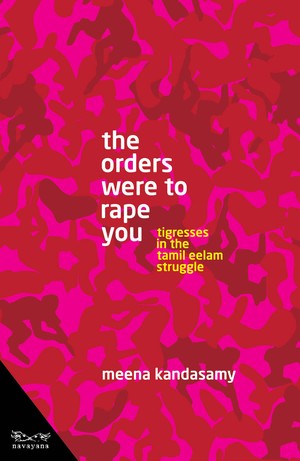
The Orders Were to Rape You by Meena Kandasamy
I know that I am supposed to laud this book for the feminism, for talking about war crimes on women. Sadly, I won't because this book did not do much for me. The book talks about Tamil Tigresses of the LTTE and gives a very brief overview of the Tamil struggle in Sri Lanka, and the role played by India in adding to the war crimes against Tamil people. I liked how the book laid out the various reasons that makes Tamil tigresses special- the fact that women were present on the warfront- a generally male-dominated place, and served as fighters, not just as the wives and mothers of fighters. Given the conservastive Tamil upbringing of the author in India where girls were not allowed to do a lot of things, these tigresses became role models to look up to. I understand that position, however, I find it beyond myself to appreciate it.
I can't express it really, but I feel wary of all notions of nationhood around an ethnic identity. Hah! I even find the notion of Ummati very weird- something which is one of the underpinnings of the religion I was raised in. This is by no means putting down the Tamil tigresses themselves, or even the stuggle in Sri Lanka, but only that I find it difficult to wrap my head around any kind of fangirling. I realize that since I am not ethnically related to a group of people in another country, my understanding is clouded. However, I am a Muslim and Musims are constantly considered a separate civilization (read Sapiens), a separate nationhood (the Muslim Ummat) but obviously there is isn't one really- and I definitely don't feel a part of it. So, it is baffling to me.
But, that's not a real critique of the book, rather a lack of understanding on the choices people make. The book itself is too short to be called a book. This could have well been an essay included in a collection of essays. The content of the book just scrapes at the top and we probably need to take up something deeper to understand Tamil resistance. Also, for war crimes against women (not specifically Tamil), 'Our Bodies Their Battlefields' is a much better read.
Feb'22
#theordersweretorapeyou #bookish #unitedbookstagram
Exceptional content and writing.
रस निष्पत्ति - वीभत्स😖, रौद्र🤬 (in readers)
भाव निर्मिति - शोक😔, भय 😨 ( in characters)
Let's ask a question
Whose hand will you hold
A Seeker or A Giver
You may say Giver, 'coz obviously Giver is contributing while seeker may ask anything of you
But what if I say that Seeker is seeking answers while Giver is inflictor of pain
You would change sides right
That's what this book will make you do. It will make you change sides. Coz you would be lost in the tumult...it will make you feel that maybe you were on wrong side all this long (if you had chosen)
...or maybe there is no side at all...coz in a war all is lost, everyone is at loss
This book though divided in 2 parts talks about the atrocities as whole. Atrocities forsaken on these women of valor
Women who invoke these powerful images of camouflaged uniforms, big guns, who are brave about death
But then how the change of sides in war has converted them into taciturn, docile women who are scared for the life of their family
The 1st part of the book talks about the long process author had to go thru' to reach these women. Get them to talk about the endless physical humiliation & torments Sri Lankan army inflicted on these LTTE tigress. There are 2 essays - by the wife of an LTTE fighter & a female combatant of LTTE
"Women raped as a weapon of war are potent tools for political mobilization and grandstanding oratory, but in everyday life, they are viewed with derision suspicion, shame."
The 2nd part is a collection of resistance poems by female guerrillas
These women accounts coherently point out to the very patrichial system in military, irrespective of the fact that these women were considered much better sharpshooter then their male counterparts
The unjust simmers the blood & makes you question that irrespective of the choices these women made, how come men had power to met out decisions they wished
Author's "on your face" writing reverbrates in your heart for days at stretch. My only qualm being that I wanted more - more essays, more about psychological traumas then physical
Read it to know how unjust world can be
Kandasamy's words have healed me: letter by letter, page by page and book by book. Her recent work speaks beautifully of what it means to be a woman, and more importantly what it means to be a tigress in the Tamil Eelam struggle. It talks of resistance and revolution and how intricately poetry serves in the face of rebellion. Based on the poetry of Tamil female fighters, this book brings a lot of perspective to their struggle and strength. Powerful as always.
To rate this book feels ethically wrong. This book, when read with a background of the current use of women's bodies as weapons across the many revolutions and genocides and wars ongoing in the world makes you want to eviscerate the words "All's fair in love and war" from human memory. How can it be? How can any justification for raping women as a tool of war be considered as fair and rational, as these army officials are supposed to be?
Trigger Warning: There are graphic mentions of brutal violence inflicted upon the LTTE tigresses by the joint operation of the Indian and Sri Lankan states, drawn from personal memories and whatever factual or statistical data available.
Somewhere in the book, Meena Kandasamy writes - "Can telling a story change a storyteller?" I asked a similar question, as a reader, "Can reading a book change its readers?" It can, and it has changed me earlier also. Many books have done so, in fact. And this one does just as the same, if not less.
The Orders Were To Rape You is a rare book. It has both a powerfully written essay, in the singularly invigorating voice of Kandasamy, and poems by the female fighters of Liberation Tigers of Tamil Eelam (LTTE). Before presenting to us these poems, filled with unspeakable violence committed against them, and their unwavering commitment to resistance and liberation of their homelands, Kandasamy tells us the stories of Tigresses, as they were called and celebrated, who recounted how they were sexually harrassed and tortured in camps of Sinhalese and Indian Army. She transcribes the audio files of these women, now in exile in countries as far away as Indonesia and Norway, to words. She wanted to make a documentary but it never happened so she decided to publish them in this book. As you read each story, you are filled with empathy for their helpless conditions and their vulnerability, but also with pride and awe for the invincible power and courage they still possess.
In the essay, Kandasamy charts a map to represent not only her connection but her love and admiration for these tigresses. She recounts many moments and incidents, from the transitioning years of her teenage to adult life, to describe how her fearless feminine feminist worldview was shaped and fuelled by the relentless struggle of the Tigresses of LTTE. She combines the personal and collective forms of resistance to try and give us perhaps a footnote to the massive undocumented savagery that massacred thousands of people, and destroyed their lives.
It is unsettling, unnerving and even numbing to read this book. But it is of utmost importance to read it, for we must see what all has been happening around us. There is no option to be unaware, or look away, for there will be many books like this in future (I hope they will come out). For now, let's read these stories and try to understand our people more closely and intimately.
Meena Kandasamy’s The Orders Were to Rape You: Tigresses in the Tamil Eelam Struggle, is in part an essay, with narratives of three Tamil women — the wife of an LTTE fighter, a female combatant from the LTTE, and the author herself. Its second part is a collection of resistance poems by female guerrillas and militants. It asks larger questions about how to expect balance and political compromises when rape and murders are being committed. In the struggle between political correctness and dignity of survivors, humanity lost. The moving account of survivors in post war Sri Lanka makes this book a great read. I'd highly recommend this one.
If the aim of this essay is to give the female warriors of Tamil Eelam a voice, Meena Kandasamy had achieved it. Let us read this book, lest we forget!
This book has educated and humbled me…
From personal experience, I have frequently felt my Sri Lankan Tamil identity to be dismissed by Indian Tamils.. They’re surprised to hear that I’m a Tamilian who is not from India. Meanwhile I am astounded how they were not aware of a genocide occurring just 50 or so kilometers from Tamil Nadu…
As such, I began the book with reservations that an Indian Tamil author is writing of the religious persecution and ethnic cleansing targeting Sri Lankan Tamils…
And though it was a quick read (only ~100 pages), I have gained a new perspective and newfound respect… I received answers for questions that have swirled around in my mind for the past two decades - What did India stand to gain? Did anyone there care about this genocide? Was anything done?
That being said, I couldn’t give The Orders Were to Rape You five stars because it felt like there was an imbalance between the depth of introspection on Meena Kandaswamy’s own perspective versus the second hand accounts of those directly affected or involved… There were so many moments that I wished there was just a little bit more… so desperate to know more about these experiences….
All in all, The Orders Were to Rape You is a must-read.
Trigger Warning: Mentions of sexual violence
In ‘Purananuru’, an anthology of four hundred Tamil poems written by more than 152 poets between the first and third centuries C.E., emperors were exalted. Their wisdom, and their valour in war were celebrated. But women were assigned certain roles. They were the martyrs’ mothers, widows, and daughters. Did women do anything other than beating their breasts, and wailing?
But in the Tamil Eelam war, women were on the front line, wielding weapons, brandishing courage, and battling to take back the land that belonged to them. The oppressors quelled their spirit by unleashing sexual violence on them, and on hundreds and hundreds of civilians who were displaced, and dehumanised.
In Meena Kandasamy’s ‘The Orders Were To Rape You’, the Tigresses, the female fighters of Liberation Tigers of Tamil Eelam, share their stories reluctantly first, and freely later in their poems. Every page is a lament. Every story is a reminder to challenge patriarchy, to not turn away when waylaid by injustice, and to question the Tamil moral universe that hurls misogynistic judgement on survivors.
Meena Kandasamy constantly asks herself, and the reader, why should the survivors be asked to live through their trauma again by relating their stories? Some of them choose to give words to their stories because they want Justice. But when will they receive it?
I see the book’s cover, and think of the poetry and pain in it. There are silhouettes of women lunging. There are rifles in their hands. When I focus on the cover softly, I see blotches of blood. Blood is omnipresent in the lives of Tigresses. When they went to war, they were killed, and violated. When they stayed back, they were still violated, and tortured. When they fled the war, the violations took unimaginable forms in foreign lands. I am often told that bodies are our only homes, and we should look after it. And the more I read about gender-based violence, I realise that bodies are not homes; they are cages. How can something feel like home when there is no safety and freedom!
Stunning book-length essay by Meena Kandasamy. I'd also recommend the documentary My daughter the terrorist for context and as a companion to this text.
Rating - 4.5 stars
NPS - 10 (Promoter)
Women raped as a weapon of war are potent tools for political mobilisation and grandstanding oratory, but in everyday life, they are viewed with derision, suspicion, shame.
A must read after reading Brotherless Night, a perspective on the women who joined LTTE and the Tamil Eelam movement and trained in warfare.
Rape is the weapon of war used in all wars to degrade, humiliate and traumatise women, men and children. It is one of the most common methods of ethnic cleansing. As an Indian Tamil who experienced sexual violence herself, Meena Kandasamy was particularly distraught by systemic violence experienced by female fighters (or, in one case, wife of a male fighter) of Liberation Tigers of Tamil Eelam, also known as Tamil Tigers, from the hands of the Sri Lankan army after the end of the Sri Lankan Civil War. She interviewed two women residing in Malaysia and Indonesia, wrote a personal essay and included poems wrote by three female Tamil Eelam resistance fighters. The result is this slim but powerful book: “The Orders Were to Rape You: Tigresses in the Tamil Eelam Struggle”.
Getting women to talk openly about their experiences wasn’t easy. “It is a society where your story cannot cross your doorstep”., Kandasamy writes about the Tamil society. One doesn’t talk about personal pain but this makes healing and reconciliation incredibly difficult. Kandasamy’s book is not only the account of brutality and torture on women. It is also a critique of Tamil nationalism and culture, in which women, even if fierce and strong, are still mistreated and taught values detrimental to their wellbeing. She writes about her own upbringing in India: “We lived in a Tamil society where girls were expected to conform to the four quintessential feminine qualities of accham, madam, naanam, payirppu (fear, ignorance, modesty, shrinking delicacy).” To be a courageous fighter and represent those ‘feminine qualities’ is a paradox.
Reading about the impact of Tamil Eelam female fighters and their poems (“To read these poems is to reclaim their rightful historical space”) made me also think about Eritrean female fighters of the Eritrean People’s Liberation Front during the war against Ethiopia in 1961-1991, who constituted 30% of the forces (exactly the same as the proportion of Tamil female fighters) and whose emancipation is well known. In both cases women played a pivotal role in the war and led to greater empowerment, ideologically rooted in socialism.
“The Orders Were to Rape You” is an excellent, thought-provoking and insightful book, making me even more interested in the role of women in war and conflict and the price they pay for their passion and engagement.
An essay on exhuming, documenting, and remembering the violence faced by women in the fight for the Tamil self-determination in Sri Lanka.
This book is an essay. It begins with the story of the author and the environment and personal experiences that shapes her solidarity for the LTTE and leads her to create a documentary that doesn't release and later takes the form of this book. It also chronologizes the events of the genocidal war of the Sri Lankan state against Tamils — mass murders, displacements, geo political policies, rehab camps, violence, and asylums.
The main content the book builds itself towards are the personal stories by women in the trenches and in the background of the Tamil Eelam fight, originally an mp3, converted into text for this book. The stories aims to reclaim and remember violence faced by two women in the hands of the army by giving it a voice and a medium. The two women are a militant's wife and a Tamil tigress who talk about their two different future hopes — freedom for one and revolution for another but very similar past lives — of rape and violence.
The essay ends with extraordinary poetry by three Tamil women combatants, translated by Meena Kandasamy. Poetry that links overall liberation to women emancipation, poetry that asks of revolution, poetry that is a tribute.
Difficult but essential reading. I am a reader who scribbles, so I sat with a pen because I knew this would be underscore and remembrance worthy and it so was. Read! I only wish it ran longer and covered more stories.
"To read these poets is to remind ourselves that the systems within which we operate as "progressive" writers are sometimes complicit with the same capitalist and imperialist systems that have allowed such voices and struggles to be annihilated. While literature is eager to celebrate the author as activist, its rarefied realm is never opened up to the activist/fighter as author."
I read the titular essay for the first time last year July when it had appeared in The White Review. It attempts to provide a brief overview of the Tamil Eelam struggle in Sri Lanka, looking at genocide and political criminality, the later CIA-like involvement of India, LTTE & what it meant to Tamils, the violent aftermath, and the camps. Kandasamy's at her self-reflexive best as she talks about her motives and goals, her childhood adoration of Tigresses, and how they proved so vulnerable against state forces. She puts two statements of survivors of the camps, culled from the material collected for her failed documentary. They are both disturbing and devastating to read.
The second piece, "The Poetry of Freedom Fighters", tries to examine "poetry as op-ed, poetry as resistance, poetry as a call to arms, poetry as a call to poetry", exploring a tradition of women writing poetry as a way to register their dissent, rebellion, resistance against the status quo. She translates poems by Captain Kasturi, Captain Vaanathi, Aatilatchumi and critically studies them, placed in Global South socio-history to highlight poetry's power as a longheld medium of protest.
The orders were to rape you; to put our seeds in your womb; to humiliate your community. The war might be over, but the atrocities continue. Meena Kandasamy presents this short book of essays and poems from female militants to give them a voice.
I remember people saying that the book title is too violent when I shared this book in my stories. This got me thinking, how come we are accustomed to reading the word 'Murder' or 'War' or 'Death' on book covers, but when it is 'Rape,' we get a bit uncomfortable. Society tends to put the onus on the victim, which baffles me.
There are three points of view in this book, one from the wife of a Tamil Tiger, one from a Tamil Tigress herself, and Kandasamy's own experiences. The narrative was meant to be in the form of a documentary, which did not end up seeing the light of day; hence this book. The writing and delivery might seem a bit off at times for that reason. It is raw; it is unfiltered; it is as it should be.
The author (Meena Kandasamy) says that this is a book about her, a Female Tigress (LTTE woman soldier) and a wife of an LTTE fighter and how the Tamil war of self determination (in Sri Lanka) affected these people.
The author is from Tamil Nadu in India. The genocide in Sri Lanka stoked the Tamil sentiments of people in India especially people in Tamil Nadu. The author's family got involved in it like so many of the other Tamils. But for the author, as a young girl who was strictly brought up thanks to the patriarchy the Tamil girls wielding AK 47 in the neighbouring country was a liberating experience. She idolised them. this was in the late 1980's.
Pause.
In 2009, when the war ended and the Tamils suffered a great defeat and when they were mercilessly killed in large numbers, the people ran to different places seeking refuge. The fighters (LTTE) were the worse affected. Those who surrendered or captured underwent worst ever suffering. The women fighters were the special cases. They were raped every now and then and in that heinous event often it was done by a group of Sinhala soldiers. They had special orders to rape the women fighters or the sympathizers of LTTE. The Tamil women were to bring up the children of the Sinhala race.
Pause.
The suffering did not end here. When the women returned to their proper households, they were mostly rejected or seen as a societal shame. Tamil society disowned them. It was better to die in the battle and be celebrated as a war hero than to be a sexually exploited war captive. The enemy ruined you physically and the own people saw you as an impure person - walking shame for the family and society.
Pause.
This book is a poignant collection of essays.
This book is in part an essay, a memoir of some sort – a dialogue with oneself, and also a collection of resistance poems by female guerrillas and militants of the Liberation Tigers of Tamil Eelam (LTTE) in Sri Lanka. It is a narrative of three Tamil women – tigresses – the wife of an LTTE fighter, a female combatant from the LTTE, and of the author herself.
What set out to become a documentary by the author, ended up becoming an essay of gruesome experiences recounted by the two survivors of war. Meena met them in Malaysia and Indonesia, in 2013, four years after the war had ended.
This book is so much more than this. It is about Kandasamy’s “childhood history of adulation and fangirling over the Tigresses”, leading to questioning all that is fed to people in the guise of news, and only one narrative being told. I think this is what actually led Meena to tell stories that were not told and to give a voice to ones that didn’t get one. It is also about genocide of the Tamil Eelam people – of the involvement of India in this, the violent aftermath and the camps. It is about the rapes of women – the brutalities, the wounds that never heal, the scars that don’t appear, and the trauma that never goes away.
The second part where Meena shares poetry of the tigresses, is more of a call for rebellion in one way. It looks at poetry by women as a way to fight back, to resist, to fight over and over against the status quo.
For me the narrative of the Tamil Tiger’s wife was most powerful and resonated so deep. It is very disturbing but needs to be told. It needed to be told in the manner Kandasamy says it – cutting no edges, hiding nothing, revealing it all for the reader.
Are these women victims or survivors? I kept asking this question to myself long after reading this text. I am still wondering. Also, the relationship of these women with Kandasamy is something I would want to read more of. The reluctance they had initially to speak with her and the opened up. What led to that? What sort of an ally one has to be to be able to evoke that? The lived and complex realities of Tamils, Tamil women, and more so Tamil women combatants in Sri Lanka through this essay will certainly give rise to much needed discourse, and we need more of those. There is a lot to unpack, a lot to take in through this slim volume of suffering, fight, and the road to liberation that is always long and hard.
Books and Authors mentioned in The Orders Were to Rape You
Nimmi Gowrinathan
Lovers and Comrades: Women’s Resistance Poetry from Central America: Edited by Amanda Hopkinson
Against Forgetting by Carolyn Forche
Mariana Yonüsg Blanco
Sandra Ramirez
Commandante Yesenia
Tichaona Nyamubaya
Lorena Barros
Aida F Santos
Anna Swir
Captain Vaanathi
Nibha Shah
Captain Kasturi
Adhilatchumi
Lil Milagro Ramirez
Poem 278 by Kakkaipatiniyar Naccellaiyar
Purananuru
Poem 112
![ஒரு மனிதன் ஒரு வீடு ஒரு உலகம் [Oru Manidhan Oru Veedu Oru Ulagam]](/media/_versions/images/books/15845657_small.jpg)

![ப்ளீஸ் இந்த புத்தகத்தை வாங்காதீங்க [Please Intha Puthakaththai Vangatheenga]](/media/_versions/images/books/15704921_small.jpg)
![அறம் [Aram]](/media/_versions/images/books/17793442_small.jpg)
![உடையார் - பாகம் 1 [Udaiyar - Part 1]](/media/_versions/images/books/6705635_small.jpg)